From Honda Aircraft to High School Sciences
How a three-week industry immersion is transforming one teacher's approach to science education
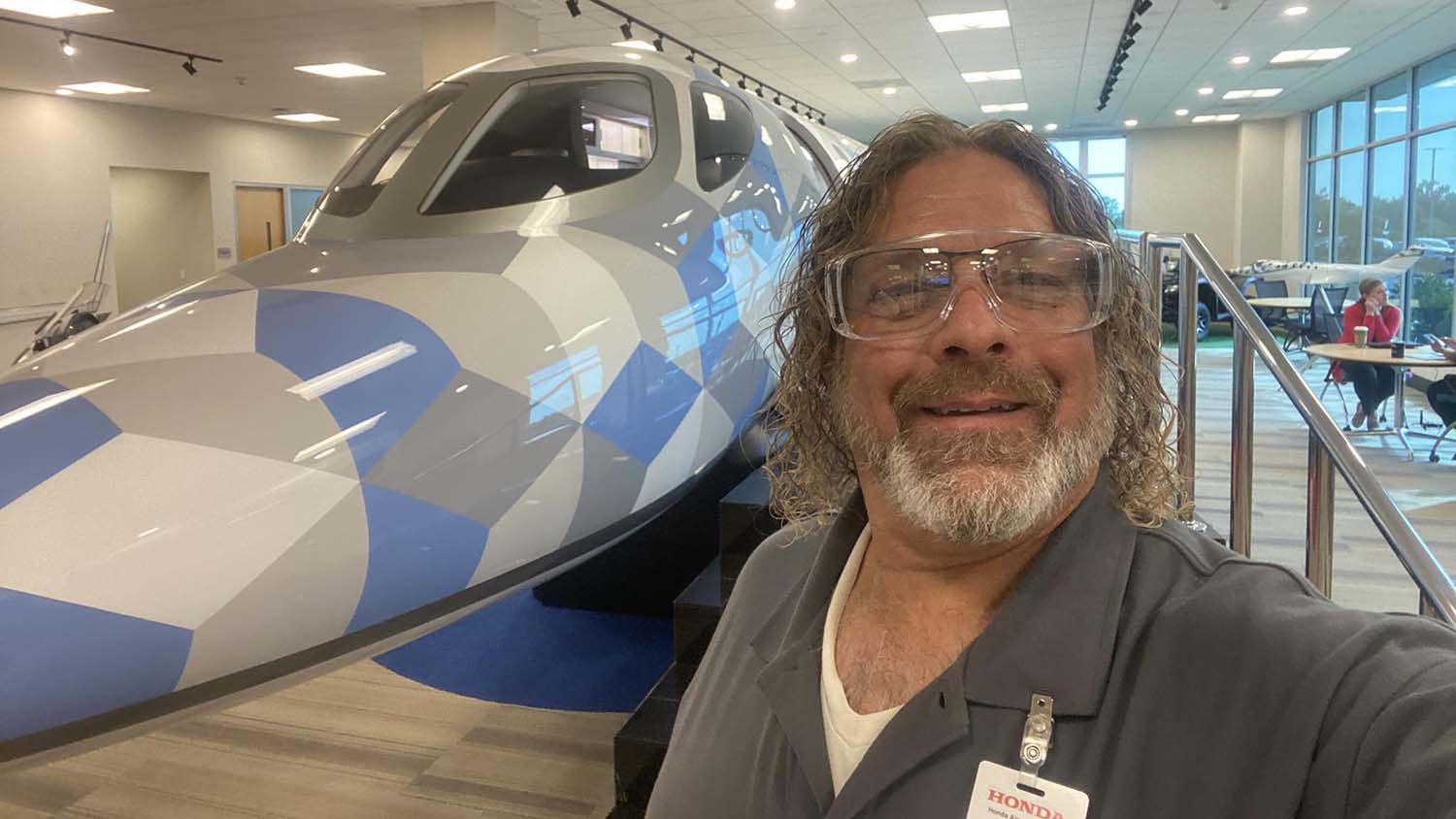
Mark Case witnessed every step of building an airplane from structural support to test flights, and he even got hands-on experience along the way. Case is a veteran science educator at Southern Guilford High School.
This summer, Case was immersed in the world of aviation manufacturing at Honda Aircraft Company in Greensboro, North Carolina. His fellowship was made possible through support from the N.C. Department of Public Instruction.
“I was able to practice putting rivets into practice supports, apply sealant on gas tanks, and help thread a wire harness. Honda went above and beyond to make sure I was able to experience every aspect of the plane manufacturing process. I even had the chance to take a simulator test flight.”
Desired Industry Skills
As he shadowed engineers, technicians, and staff across departments, Case discovered two valuable workplace expectations: be on time and take school seriously.
“The terms and vocabulary might be different, but the concepts I teach are used every day at Honda,” Case explained. “I need to be diligent to make sure students understand that what we learn in science class connects directly to industry.”
Employees at every level, from custodians to chief engineers, welcomed Case. “Every time I introduced myself as the Kenan Fellow, they were excited to meet me,” he said.
Challenges and Surprises
What surprised Case most was the energy of Honda’s workplace culture. “Every employee I met liked their job. They look forward to working. They go out of their way to help each other. I don’t remember the last place I’ve been where people truly want to be there.”
The biggest challenge, he admitted, was simply figuring out how best to contribute.
“They didn’t know what to do with me at first,” Case explained. “But they enjoyed hearing how education terms lined up, or didn’t, with industry [terminology]. For example, ‘diffusion’ in science class means something slightly different than ‘wave diffusion’ in aviation.”
Bringing New Insights Back to Students
Case left with a clear sense of urgency: schools and industry must connect more directly.
“Guilford County Schools has the raw material: our students. Honda needs that raw material, refined into workers,” he said.
Inspired by his experience, Case is developing new lessons around sound waves and their applications in aviation.
“Honda works to reduce noise and sound interference in the cockpit and cabin,” he explained. “Kids love music and always have earbuds in, but they don’t realize the long-term damage or the science behind it. I plan to use simple speakers and baking sheets to create Chladni plates that turn sound into visible patterns. We’ll explore constructive and destructive interference just like Honda engineers do.”
- Categories: